Say you have a £150 cashmere jumper. You throw it in the machine on a normal wash. It comes out doll-sized, matted, and unwearable. That is the mistake most people make at least once. Here is how to make sure it is not you.
The short answer
Water-safe fabrics like cotton, linen, denim, and most polyester can be washed at home or through a wash service. Structured or delicate items like tailored suits, silk, cashmere, wool coats, and leather need dry cleaning. When in doubt, the care label wins.
Learn to read a care label in 60 seconds
Every clothing label has five symbols that tell you exactly how to care for the garment. Learn these and you avoid most disasters.
- Wash tub tells you if it can be machine washed, and at what temperature. A crossed-out tub means do not wash.
- Triangle tells you if bleach is safe. Empty triangle means any bleach. Crossed out means none.
- Square tells you how to dry. A circle inside means tumble dry. Lines inside mean drip, line, or flat dry.
- Iron tells you if you can iron, and at what heat. Dots inside indicate temperature.
- Circle is the key one for this article. A plain circle means dry clean. A crossed-out circle means do not dry clean. Letters inside (P, F, W) tell the dry cleaner which solvent to use.
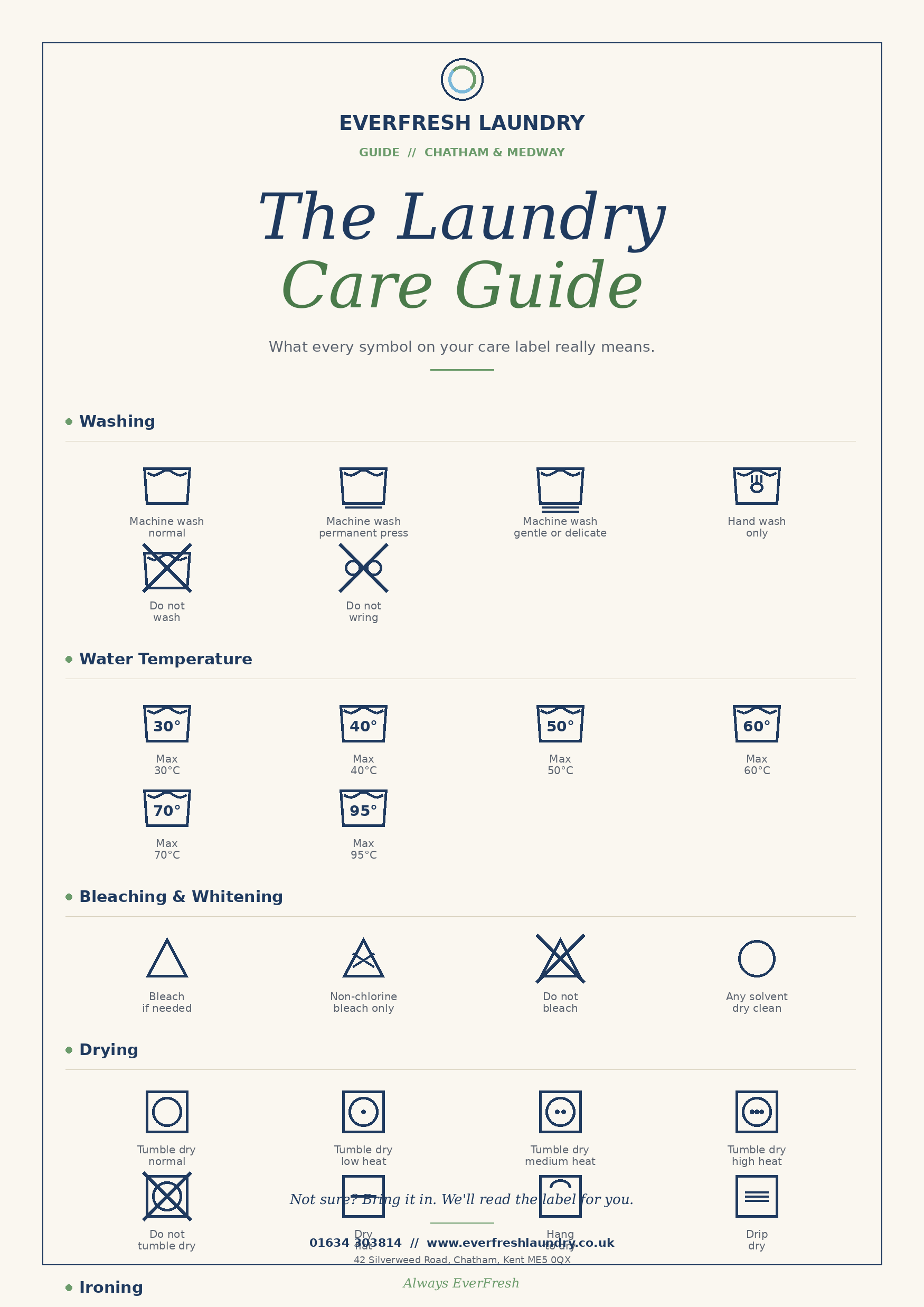
If you want a full reference to keep at home, we made a laundry care guide poster with all the symbols explained. Pin it up in your utility room.
"The care label is not a suggestion. It is instructions from the person who chose the fabric, cut the pattern, and knows exactly what will and will not work."
EverFresh Team
Fabrics that must be dry cleaned
Some fabrics simply do not survive water. The fibres swell, the dyes bleed, the structure collapses. If the label says dry clean only, believe it. Common examples:
- Silk. Water causes staining and dye migration. Some silk is hand-wash safe, most is not.
- Cashmere and structured wool. Wet wool felts, shrinks, and loses its shape.
- Tailored suits. The internal canvas that gives a suit its shape cannot be washed.
- Leather and suede. Water damages the surface irreversibly.
- Sequined, beaded, or embellished items. Water loosens adhesives and threads.
- Taffeta, velvet, and structured evening wear. Water damages the finish.
Fabrics that should be washed
On the other side, many fabrics actually do better in water than in solvent. Washing removes body oils and sweat more effectively than dry cleaning does.
- Cotton. Designed for water. Machine washable in most cases.
- Linen. Best washed gently, air dried, ironed while damp.
- Denim. Wash inside out in cold water to preserve colour.
- Polyester. Very forgiving. Machine washable at moderate temperatures.
- Machine-washable wool blends. The label will say so. Use a wool cycle.
The grey zone
Some items sit awkwardly between the two. Silk shirts, for example, vary widely, some are hand-wash safe, others are strictly dry clean. It depends on how the silk was woven, whether the dye was fixed, and how the buttons and interfacing were attached. Wool suit trousers can often be washed even if the jacket cannot, because the jacket has structured canvas inside that the trousers do not. Vintage or inherited pieces are the trickiest, older fabrics behave in unpredictable ways and dyes from decades past were not always colourfast.
Rule of thumb: when the fabric is expensive, the item is structured, the label is ambiguous, or the piece is irreplaceable, dry clean. The cost of dry cleaning is always less than the cost of replacement.
How to test at home when the label is gone
Care labels sometimes fall off, get cut out for comfort, or fade beyond reading. When you cannot tell what the label said, use the fabric burn test alternative: the visual and touch test.
- Look at the weave. Tight, structured, and lustrous usually means silk, cashmere, or fine wool, dry clean.
- Feel the weight. Heavy, structured items with internal lining almost always need dry cleaning.
- Check the finish. Any coating, sheen, or crinkle finish is likely to be damaged by water.
- Test a hidden seam. Dab a wet cotton bud on an inside hem. If colour transfers to the bud, do not wash.
None of this replaces a proper care label, but it prevents the worst mistakes when the label is missing.
What dry cleaning actually does
Dry cleaning is not really dry. It uses a liquid solvent (usually perchloroethylene or a modern hydrocarbon alternative) instead of water. The solvent dissolves oil-based stains and lifts dirt without swelling the fibres or causing dyes to bleed.
The trade-off: dry cleaning is less effective on water-based stains (sweat, some food, drinks), which is why washing is actually better for cotton shirts you sweat in. Professional dry cleaners spot-treat water-based stains before the solvent cycle to get around this.
Modern dry cleaners like our trusted specialist partners use closed-loop machines that recover and recycle the solvent, so the environmental impact is far lower than it was twenty years ago.
Or, let us decide
If reading care labels feels like a chore, that is fine. Our Wash, Dry & Iron service sorts every item at intake and flags anything that should be dry cleaned instead. If we spot something that needs specialist care, we route it to our dry cleaning service automatically and let you know. No damaged jumpers, no guesswork.
The bottom line
Read the label first. If it says dry clean only, believe it. If it says wash, check the fabric content. If in doubt, ask a professional. The cost of a second opinion is always less than the cost of a ruined garment.